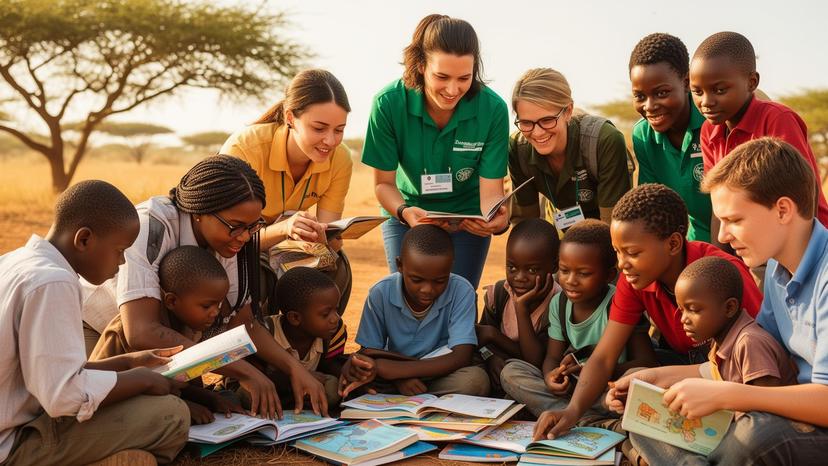
Teaching
How Teaching in Kenya Changed My Career Path
"Sarah spent three months teaching at Ombogu Primary School and returned home with a new purpose in life."
Sarah Mitchell
🌍 Summer 2026 Programs Now Open! Secure your spot on a life-changing volunteer program — Limited spots — limited spaces available!Explore programs →
"Sophie tracks lemur populations annually in Madagascar, building lasting ties with a community she now calls family."
The first time I went to Madagascar, I was a wide-eyed master's student collecting data for my thesis on indri lemur vocalizations. The second time, I was a researcher returning to update population surveys. The third time — and every time since — I go because Andasibe has become home in a way I never expected.
Madagascar is unlike anywhere else on Earth. Ninety percent of its wildlife is found nowhere else, and the lemurs — those strange, beautiful primates with their enormous eyes and haunting calls — are among the most endangered mammals on the planet. The Andasibe-Mantadia corridor where I work is one of their last strongholds.
My annual visits follow a rhythm now. I arrive in September when the indris start their breeding season. For two months, I lead a team of local research assistants through the forest, recording lemur calls, mapping territory boundaries, and conducting population censuses. The data feeds into a longitudinal study that now spans five years of continuous monitoring.
"Docteur Sophie is back!" the children shout when I arrive in the village each year. They run alongside my vehicle, and within hours I'm sitting in Mama Razafy's kitchen eating rice and laoka as if I never left. The continuity of returning — year after year, to the same place and the same people — has created bonds that a single volunteer trip never could.
The conservation picture is complicated. Lemur habitat continues to shrink due to slash-and-burn agriculture, logging, and charcoal production. But in our study area, community-based conservation programs are making a measurable difference. Families who once hunted lemurs now earn income as research assistants, guides, and conservation monitors. The data shows it: indri populations in our corridor have stabilized for the first time in decades.
Jean-Baptiste, my lead research assistant, started as a subsistence farmer who I hired on my first visit to carry equipment. He's now a skilled field researcher who can identify individual lemurs by their calls and has co-authored two published papers. His transformation embodies what long-term, relationship-based conservation can achieve.
People ask me why I keep going back when there are so many other places that need help. The answer is that depth matters more than breadth. By returning annually, I've built trust, institutional knowledge, and a dataset that no one-off project could replicate. I've watched children grow up, attended weddings, mourned losses, and celebrated births. Conservation isn't just about animals — it's about the people who share their landscape. Madagascar taught me that lasting change requires lasting commitment. I'll keep going back for as long as the lemurs sing.
Get volunteer tips, destination guides, and opportunities delivered to your inbox.
"Sarah spent three months teaching at Ombogu Primary School and returned home with a new purpose in life."
Sarah Mitchell
"James left his corporate job to spend 6 months at a wildlife sanctuary. Now he's a full-time conservationist."
James Chen